The Hidden People of North Korea by Ralph Hassig & Kongdan Oh
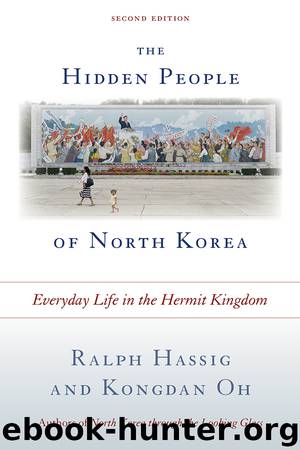
Author:Ralph Hassig & Kongdan Oh [Hassig, Ralph & Oh, Kongdan]
Language: eng
Format: epub
Publisher: Rowman & Littlefield Publishers
Published: 2015-09-22T16:00:00+00:00
Despite the regime’s insistence that capitalism is doomed to be replaced by communism, some students are being explicitly exposed to capitalist ideas to prepare them to do business with foreigners. As early as 1996, Kim Il-sung University offered a few lectures on capitalism—originally taught by professors visiting from North Korean–affiliated universities in Japan.37 In recent years, North Korean students have also been sent abroad in small groups to study capitalism, especially to Chinese universities. Students have also been sent to Western countries, including several hundred to the United States, usually for a period of a few weeks or months. The longest-running American exchange program, implemented in 2002, is a computer sciences program jointly administered by North Korea’s Kim Chaek University of Technology and Syracuse University.
It is difficult to say exactly how much ideological education students receive because academic subjects are suffused with ideology and the worship of the Kim family. The first songs students learn are songs of praise for the Kims. In history class, they study the military victories of the Kims. In math class, they work on problems about how many American soldiers North Korean soldiers can kill. In art classes, they draw pictures of the Kim family home. A first-grade reader shows little children gleefully playing with a remote-controlled toy tank, along with the poem:
Mini-tank advances,
Our tank advances,
Crushing American bastards,
Mini-tank advances.
In 2012 the government revised and upgraded the educational system. Children have one year of kindergarten, five years of primary school (adding one year), and six years of middle school, for a total of twelve years. It is at least the government’s intention to improve basic education and adopt foreign educational methods. The school year starts in April, and a typical school day begins as students assemble on street corners at 7 a.m. and march off to school behind their homeroom leader. The first half hour of school is devoted to listening to the teacher read the news or present political messages—the same activity their parents are participating in at work. Classes begin at 8 a.m., with a lunch break at noon. Elementary school children do not attend classes in the afternoon while middle school students have classes until 3 or 4 p.m. In better times, children brought lunches of rice and vegetables; today some students in rural areas are lucky if they can bring a cupful of corn kernels.
Like adults, children are kept busy with group activities. After school they perform school and community service, and once or twice a week they participate in the children’s version of political-criticism sessions where they write down “mistakes” they have made and indicate how they will make their lives better. Children also participate in group sports activities. Gymnastics is highly developed and showcased in mass displays in Pyongyang. Soccer, basketball, and table tennis are played outdoors at schools and in parks when the weather is warm; in the winter, ice skating is popular. All of these activities can be pursued with a minimum of equipment and facilities. Sports like
Download
This site does not store any files on its server. We only index and link to content provided by other sites. Please contact the content providers to delete copyright contents if any and email us, we'll remove relevant links or contents immediately.
| Arms Control | Diplomacy |
| Security | Trades & Tariffs |
| Treaties | African |
| Asian | Australian & Oceanian |
| Canadian | Caribbean & Latin American |
| European | Middle Eastern |
| Russian & Former Soviet Union |
The Secret History by Donna Tartt(19118)
The Social Justice Warrior Handbook by Lisa De Pasquale(12198)
Thirteen Reasons Why by Jay Asher(8925)
This Is How You Lose Her by Junot Diaz(6899)
Weapons of Math Destruction by Cathy O'Neil(6288)
Zero to One by Peter Thiel(5810)
Beartown by Fredrik Backman(5772)
The Myth of the Strong Leader by Archie Brown(5515)
The Fire Next Time by James Baldwin(5458)
How Democracies Die by Steven Levitsky & Daniel Ziblatt(5226)
Promise Me, Dad by Joe Biden(5160)
Stone's Rules by Roger Stone(5092)
A Higher Loyalty: Truth, Lies, and Leadership by James Comey(4971)
100 Deadly Skills by Clint Emerson(4936)
Rise and Kill First by Ronen Bergman(4802)
Secrecy World by Jake Bernstein(4758)
The David Icke Guide to the Global Conspiracy (and how to end it) by David Icke(4725)
The Farm by Tom Rob Smith(4518)
The Doomsday Machine by Daniel Ellsberg(4495)
